Test
This set of classic/regression test-cases are located under Tests/
The code will be tested periodically against these regression test to validate merges, versions, etc.
| Test | Type | Description |
|---|---|---|
| Test1 | 1D | Sod's tube |
| Test2 | 1D | Shu-Osher |
| Test3 | 2D | Riemann 2D (multiple) |
| Test4 | 2D | Step |
| Test5 | 2D | Flat Plate Hypersonic |
| Test6 | 2D | Cylinder |
| Test7 | 2D | Shock Reflection |
| Test8 | 2D | Shock Reflection + EB |
| Test9 | 3D | TGV |
| Test10 | 3D | MMS |
| Test11 | 2D | Raleigh Tatylor |
| Test12 | 2D | Detonation Difraction |
| Test13 | 1D | Premixed flame |
Test 1
The Sod Shock tube is a classical Riemann problem used to test the accuracy of computational methods
The initial conditions are very simple for this problem: a contact discontinuity separating gas with different pressure and density, and zero velocity everywhere. In the standard case the density and pressure on the left are unity, The density on the right side of the diaphragm is 0.125 and the pressure is 0.1. More details about this classic case can be obtained from Laney1 and Toro books. The solution is plotted at t=0.2
| tested | grid | comment |
|---|---|---|
| gcc 11.3(Linux), 13.x (Mac) | 200 | Euler, 200 steps, no-AMR |
The exact solution is calculated using ToroExact
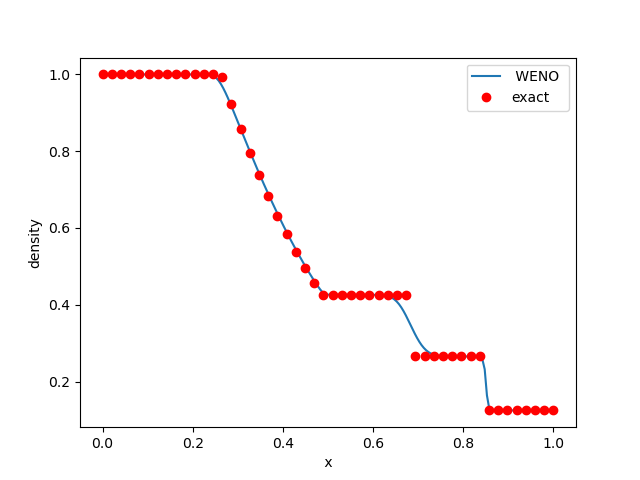
After compiling using make to run type
$ ./Cerisse1d.gnu.ex inputs
It should run very fast (5 secs, depending on machine) The results can be seen by
$ python plt.py
Test 2
The Shu-Osher Problem is a one-dimensional shock-turbulence interaction in which a shock propagates into a density field with artificial fluctuations. The goal is to test the capability to accurately capture a shock wave, its interaction with an unsteady density field, and the waves propagating downstream of the shock.
The initial conditions on a domain [0,10] are:
After compiling using make to run type
$ ./Cerisse1d.gnu.ex inputs
The figure shows three resolutiona
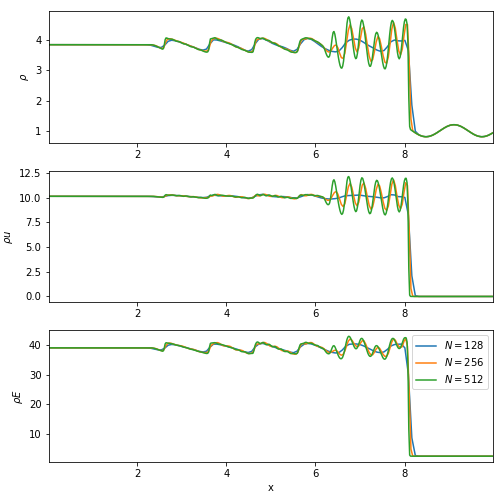
NOT FULLY TESTED
Test 3
This is a standard test case for Euler equation solvers. It can be used to test the reconstruction scheme, AMR, and numerical stability. The initial conditions are adopted from Kurganov & Tadmor (2002).
The following figure shows the all 19 configurations in the reference. All cases are run by TENO5 scheme with characteristic variable interpolation to ensure minimal numerical dissipation.
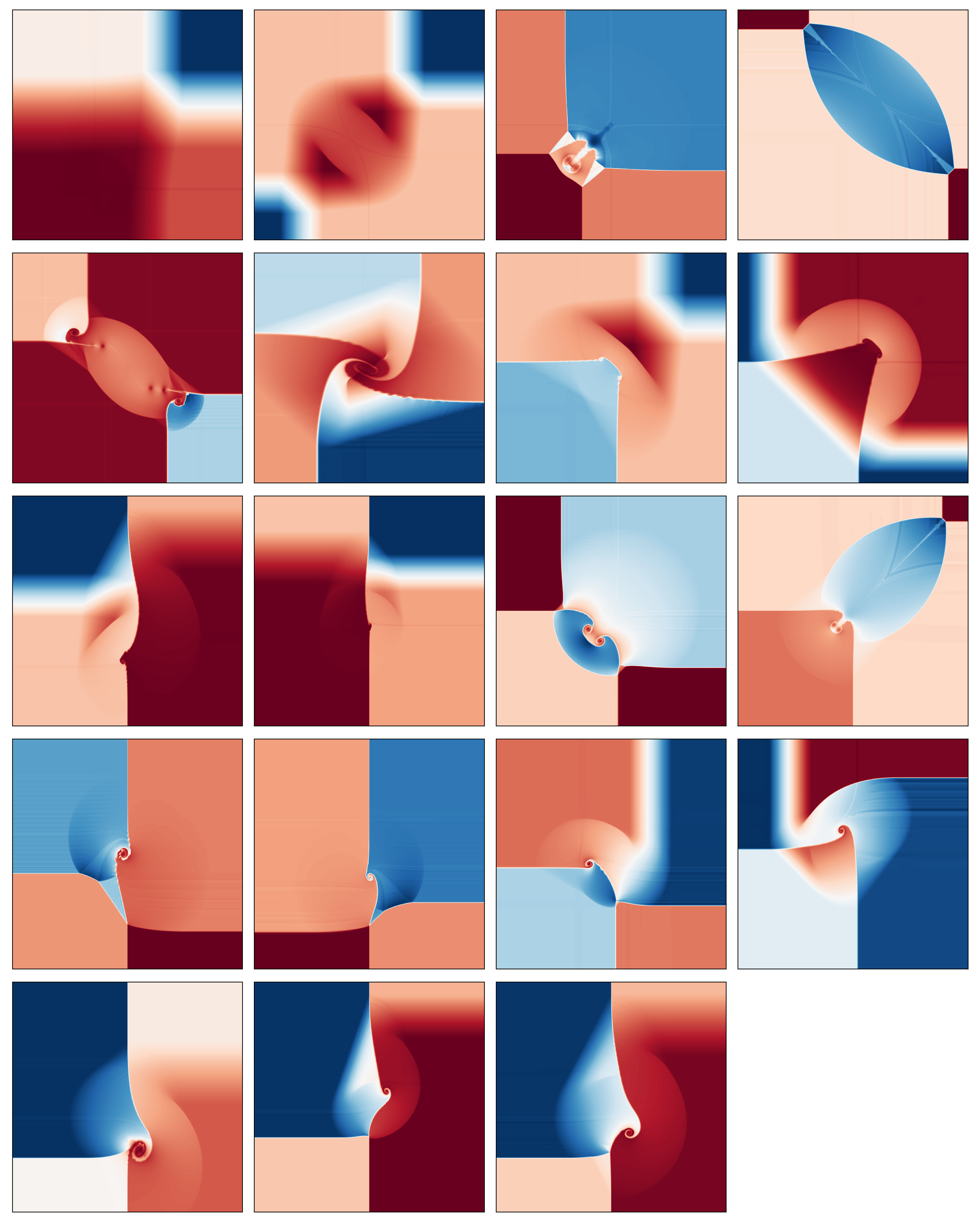
After compiling using make to run type
$ ./Cerisse2d.gnu.ex inputs